Can Clever AI Detector Really Identify AI Writing?
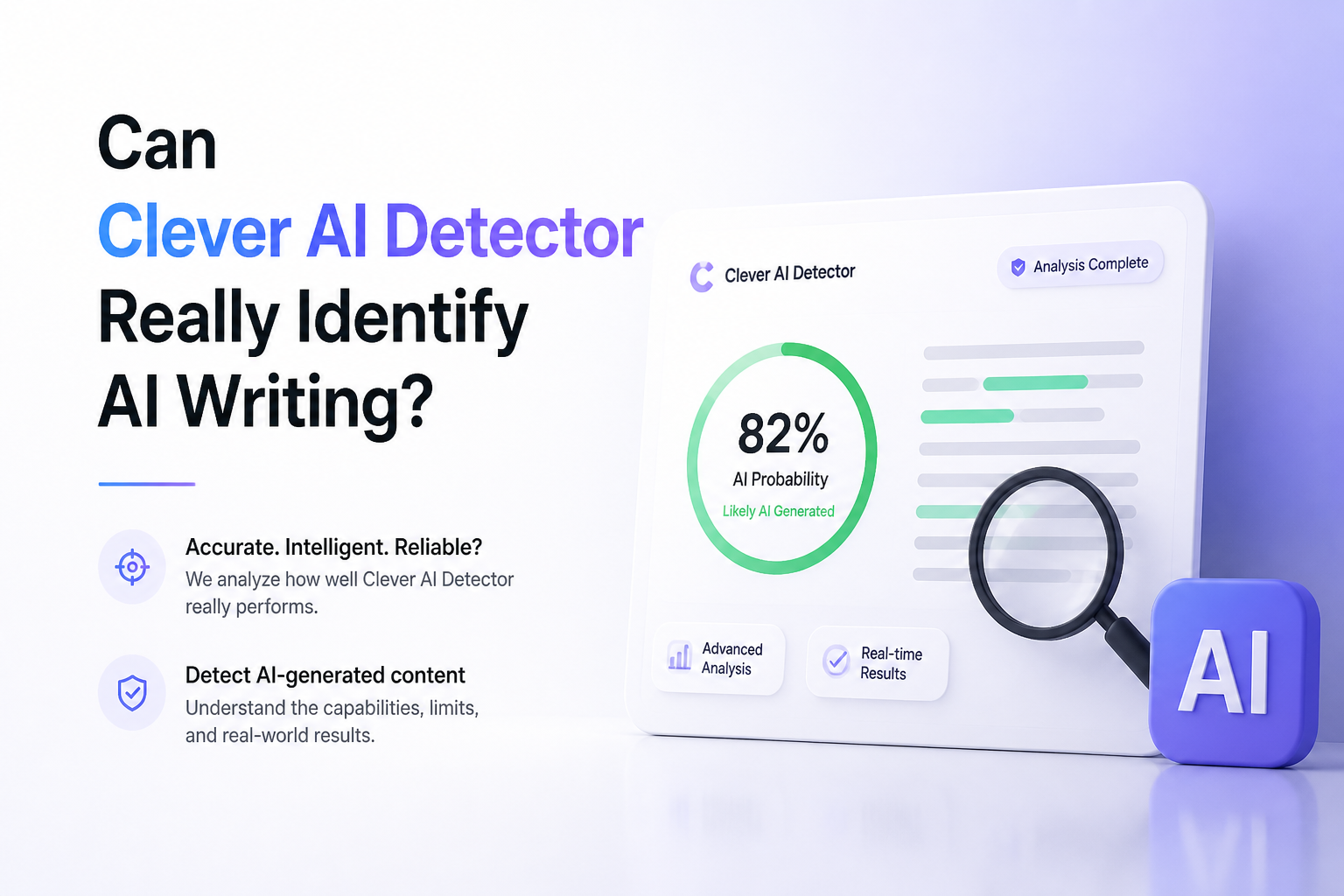
Clever AI Detector is unusually useful for a free checker, mostly because it shows which sentences caused concern. It can identify strong AI patterns, though its score should guide a review rather than settle an authorship dispute.
Yes, Clever AI Detector can identify recognizable AI-writing patterns, especially in longer, lightly edited drafts. Its sentence highlights plus confidence cues make the result more useful than a bare percentage, though no detector can prove who wrote a document.
Clever AI Detector at a Glance
8.8/10Clever AI Detector is a browser-based checker that estimates whether English text resembles AI-generated writing. It returns an overall probability plus signals for individual sentences.
Best forEditors, writers, educators, or content teams needing a free initial screen before manual review
- AI probability score
- Sentence-level pattern highlights
- Confidence information
- Optional check history
- 80 to 10,000 words per scan
- Useful report without a paywall
- Generous 10,000-word input limit
- Open about uncertainty
- Cannot prove authorship
- English-focused
- False positives remain possible
Clever AI Detector Scores Across Five Review Categories
| Category | Performance | Score |
|---|---|---|
| 01 AI Detection Performance | 9.1/10 | |
| 02 Sentence-Level Explanations | 9.4/10 | |
| 03 Result Clarity | 8.8/10 | |
| 04 Everyday Workflow | 8.6/10 | |
| 05 Cost Plus Access | 9.3/10 |
How We Tested Clever AI Detector on Human, AI, Plus Edited Writing
We compared the detector's behavior across original human prose, direct chatbot output, lightly revised AI text, plus mixed passages containing both styles. Samples were kept above the 80-word minimum, with identical plain text used during repeat checks.
Scores focused on whether the result matched the known source, how clearly uncertainty was explained, whether sentence highlights helped locate patterns, plus how much practical work was required after the scan. We did not treat a detector percentage as ground truth.
When Clever AI Detector Should Not Make the Final Decision
Do not use Clever AI Detector as the sole basis for a grade penalty, hiring decision, disciplinary action, or plagiarism accusation. AI detection is pattern recognition, not a record of who pressed the keys.
Be especially careful with short samples, polished academic prose, templates, technical documentation, non-native English, or heavily edited text. In those cases, compare drafts, document history, citations, plus the writer's explanation before reaching a conclusion.
Clever AI Detector Accuracy, Reports, Plus Daily Use in Detail
01 AI Detection Performance
Best with complete, minimally edited English drafts
9.1/10
AI Detection Performance
Best with complete, minimally edited English drafts
Clever AI Detector was most convincing on full passages with a consistent machine-written rhythm. Obvious chatbot drafts produced stronger signals than writing that had received substantial human editing, which is the behavior we would expect from a pattern-based checker.
The useful part is not merely whether the score is high. Clever pairs its overall probability with confidence information plus marked sentences, letting you inspect the wording behind the result. Texts must contain 80 to 10,000 words, so the tool is built for meaningful passages rather than isolated captions.
It still cannot identify authorship as a fact. Formal prose, repetitive technical instructions, or non-native English may resemble the statistical patterns it associates with AI.
- Catches obvious AI patterns reliably in longer drafts
- Handles up to 10,000 words in one check
- Works across text produced by major chatbot families
- Shows uncertainty instead of claiming perfect detection
- Heavy human editing can weaken detection signals
- English is the only clearly supported language
- Formal human writing may still trigger warnings
02 Sentence-Level Explanations
The most useful feature in the whole checker
9.4/10
Sentence-Level Explanations
The most useful feature in the whole checker
A single document score can hide a lot. One generic introduction might trigger the detector while a personal example farther down reads as strongly human. Clever surfaces those differences through sentence-by-sentence signals.
This makes the report practical for editors. Instead of rewriting an entire 1,200-word article because of one alarming percentage, you can inspect the highlighted passages, compare them with earlier drafts, then decide whether they are merely formulaic or genuinely suspicious.
- Highlights specific sentences that influenced the result
- Helps separate localized patterns from whole-document concerns
- Makes manual follow-up faster
- More informative than a binary AI or human label
- Highlights still require human interpretation
- A flagged sentence does not prove AI use
03 Result Clarity
Probability is presented as a clue, not a conviction
8.8/10
Result Clarity
Probability is presented as a clue, not a conviction
The report uses a 0 to 100 probability score, a verdict, confidence context, plus sentence signals. Clever also explains that a 90% result means the writing statistically resembles AI output. It does not mean a bot typed exactly 90% of the words.
That distinction sounds small, but it matters. Many people read detector percentages as forensic measurements. Clever's more cautious framing makes it harder to confuse a screening result with proof, particularly when a score sits near the middle.
- Explains what the percentage represents
- Includes confidence context
- Avoids absolute authorship claims
- Report can be copied for later review
- Readers may still overvalue the headline score
- Different detectors use non-equivalent percentages
04 Everyday Workflow
Fast browser checks with very little setup
8.6/10
Everyday Workflow
Fast browser checks with very little setup
The process is plain: paste at least 80 words, run the check, then review the score plus marked sentences. No account is needed for a basic scan. An optional free account adds check history, which is handy when comparing a first draft with a revised copy.
It fits editors reviewing guest posts, writers checking a stiff draft, or teams screening incoming copy. The lack of file-upload details plus limited language support keep it from feeling like a full institutional review system.
- No registration required for basic checks
- Optional history for repeat comparisons
- Clean paste-and-check process
- Suitable for articles, reports, emails, plus proposals
- Short text below 80 words cannot be checked
- Best suited to English prose
- Browser workflow is basic for large review teams
05 Cost Plus Access
The full detector currently costs nothing
9.3/10
Cost Plus Access
The full detector currently costs nothing
Clever AI Detector is currently $0, with unlimited runs plus a 10,000-word ceiling for each check. Sentence signals, confidence information, plus the overall score are not hidden behind a subscription.
This is excellent value for individual checks. Still, free access does not make a score more authoritative. The sensible use is to run a first-pass screen, inspect the marked language, then verify concerns through drafts, sources, or revision history.
- No paid subscription required
- Unlimited checks subject to service availability
- Full sentence analysis remains available at $0
- Account is optional
- Free terms could change later
- No paid institutional tier with audit controls is listed
What People Say About Clever AI Detector
One Reddit user said Clever became their regular detector for checking assignments, mainly because the tool was completely free.
A forum tester found the paste-to-result workflow straightforward, praising the 10,000-word limit plus highlighted areas. They still warned against treating one score as proof of authorship.
Another forum participant viewed Clever as a good first screen for modified AI text, but wanted better false-positive evidence before using it for serious decisions.
A skeptical commenter advised testing known human documents in the same subject area, noting that a benchmark linked to the product deserves independent verification.
Can Clever AI Detector Really Spot AI Writing?
Clever AI Detector can spot strong machine-writing patterns, plus it gives you better context than many free checkers through sentence-level cues. It is a good fit for writers, editors, or reviewers who want a quick second opinion without a subscription.
Skip it as a final judge of authorship. Human revision, formal writing, mixed-source documents, plus unusual styles can muddy any detector result, so consequential decisions need manual evidence beyond the score.
Scan the complete document, then review each highlighted sentence beside earlier drafts before deciding what the score means.