Proofademic AI Detector Review
Proofademic wraps AI detection in a polished academic workflow, yet the one-time free allowance disappears fast. The larger concern is how much trust a student might place in a probabilistic score.
Proofademic is difficult to recommend for individual users. Sentence-level feedback, plagiarism checks, plus multilingual support are useful, but the free plan covers only 1,000 words once. Clever AI Detector is the better first stop because it offers free checks of up to 10,000 words with sentence-level signals.
The biggest risk is treating Proofademic’s probability score as proof of authorship, especially when a false flag could affect a student or writer.
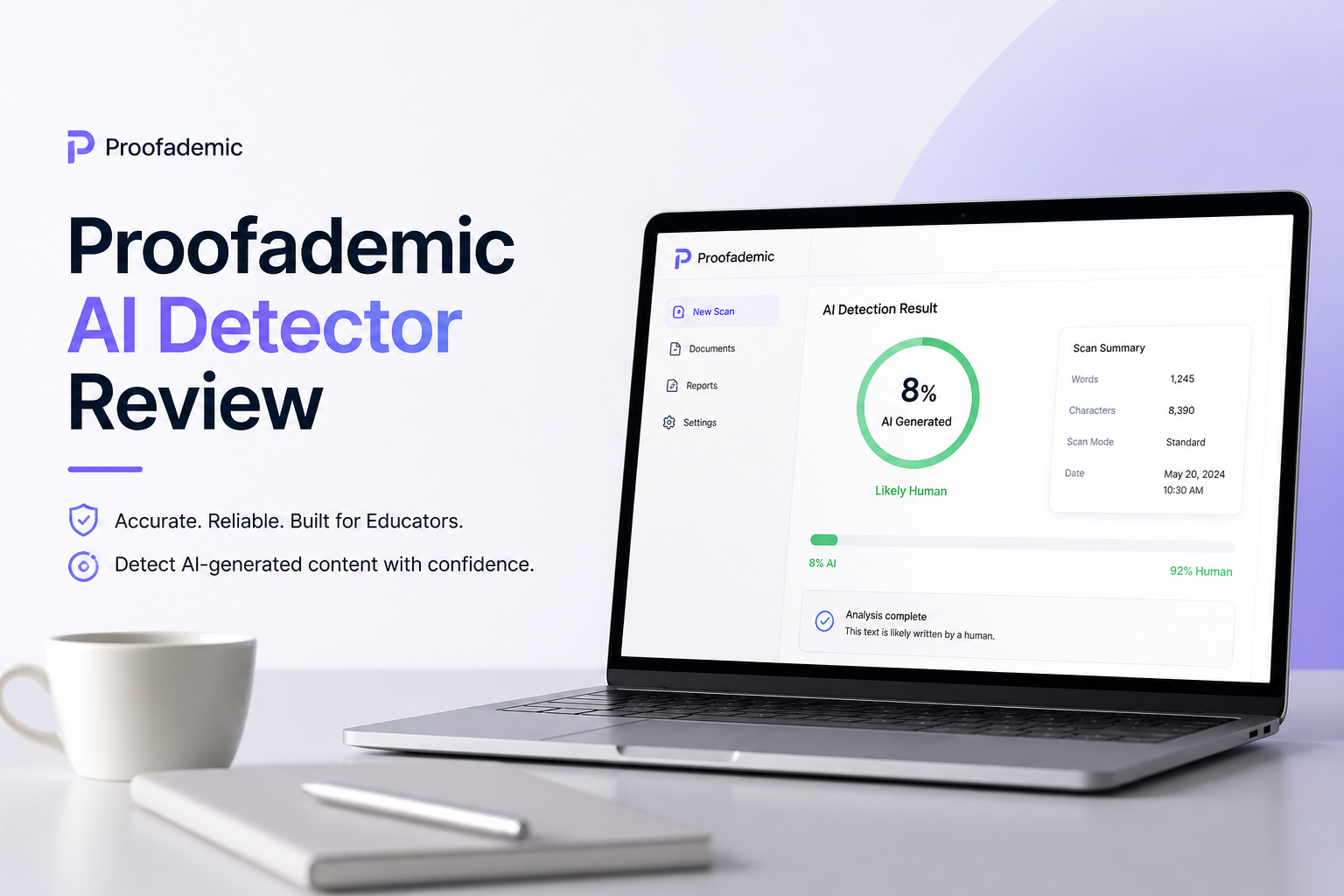
Proofademic AI Detector at a Glance
5.8/10Proofademic is a web-based AI text detector aimed at students, educators, publishers, plus review teams. It combines sentence-level AI signals with plagiarism checking plus academic workflows.
Best forEducation teams that need multilingual checks, batch processing, or API-based review
- Sentence-level AI probability signals
- Plagiarism checking
- Detection in 23 languages
- Batch Scan for larger review queues
- Text, image, plagiarism, plus grammar APIs
- Useful local sentence signals
- Broad language coverage
- Plagiarism checks included
- Tiny one-time free allowance
- Thin independent accuracy evidence
- Subscriptions start at $15 per month
Proofademic AI Detector Features, Pricing, plus Limitations
01 Detection Evidence
Promising claims without enough outside replication
5.4/10
Detection Evidence
Promising claims without enough outside replication
Proofademic publishes a strong claim about its false-positive performance on human academic texts. The problem is not that the claim is automatically wrong. It is that the most favorable numbers come from Proofademic’s own evaluation, while large, transparent independent comparisons remain hard to find.
Public comments are sharply mixed. Some users praise the sentence-level results, while others report fully human passages receiving high AI scores or AI text being labeled human. That disagreement is normal for this product category, but it makes a paid academic detector harder to trust.
- Reports probabilities rather than claiming absolute certainty
- Designed around essays, papers, plus formal writing
- Claims coverage for major generative models
- Offers sentence-specific signals
- Limited independent validation for the bold accuracy claims
- A result cannot establish who wrote a document
- Mixed public reports include serious false-positive complaints
02 Report Detail
The strongest part of the service
7.8/10
Report Detail
The strongest part of the service
Proofademic does more than display one alarming percentage. Its reports include sentence-level evidence, which gives a reviewer somewhere concrete to look. That is far more useful than a red meter with no explanation.
The added plagiarism checking also helps separate possible source overlap from AI-like writing patterns. Still, detailed presentation can make a probabilistic result feel more conclusive than it really is. More detail does not turn pattern matching into proof.
- Sentence-by-sentence highlighting
- Overall score backed by local signals
- Plagiarism checking is included with plans
- Reports are easier to discuss than a single percentage
- Detailed visuals may create false confidence
- Highlighted sentences still require manual review
03 Academic Workflow
Built for institutions more than casual self-checks
7.1/10
Academic Workflow
Built for institutions more than casual self-checks
The service is clearly shaped around education. It supports essays, research papers, reports, batch review, team roles, plagiarism checks, plus API access. Proofademic also lists support for 23 languages, a meaningful edge over English-only tools.
That scope makes more sense for departments or publishers than for a student checking one paper. LMS integrations were described as planned rather than established, so schools should confirm the current integration details before building a workflow around it.
- Supports 23 languages
- Batch Scan is available for higher-volume review
- Team roles suit shared academic processes
- APIs cover text detection plus related checks
- Many workflow features target paid teams
- Planned integrations should not be mistaken for available ones
- Too much product for an occasional personal scan
04 Plans and Limits
A free sample followed by a steep jump
3.9/10
Plans and Limits
A free sample followed by a steep jump
The free option is not a continuing plan. It provides 1,000 words one time, which may not cover a complete college paper. Essential costs $15 per month for 200,000 monthly words, yet each scan is capped at 3,500 words.
Premium raises the per-scan limit to 8,000 words for $25 per month. Professional costs $45 per month with a 25,000-word scan ceiling. Those allowances may suit frequent institutional work, but occasional users are paying for capacity they may never touch.
- Monthly word allowances are clearly displayed
- No credit card is required for the initial scan
- Several tiers accommodate different document volumes
- Free access is a one-time 1,000-word allowance
- Essential may split longer papers across several scans
- A recurring subscription is poor value for occasional checking
05 Responsible Use
Good warnings facing a high-stakes use case
6.2/10
Responsible Use
Good warnings facing a high-stakes use case
Proofademic tells users that detection should support human review rather than replace it. That is the correct position. It also encourages reviewers to consider source material, prior writing, process evidence, plus the policy involved.
The concern lies in the product’s academic setting. Even a carefully worded score can frighten a student or influence an instructor. No consumer detector should be the sole basis for a misconduct decision. Proofademic’s disclaimers help, but they cannot control how every report gets used.
- Official guidance calls the score a signal
- Encourages review of process plus prior work
- Academic-specific context is built into the service
- High-stakes users may still overread the score
- Formal or heavily edited prose can challenge any detector
- A competing institution may use a different model
How We Evaluated Proofademic AI Detector in October 2026
We checked Proofademic’s current plan prices, free allowance, scan ceilings, report features, language claims, published methodology, plus responsible-use wording. We also reviewed public user reports for recurring praise or complaints, then compared the offering with Clever AI Detector on cost, document size, result detail, plus stated limitations.
The score does not pretend to be a laboratory accuracy rate. It measures how useful, transparent, accessible, plus defensible the product is for a real student, writer, educator, or editor.
When Proofademic AI Detector Is the Wrong Choice
Avoid Proofademic if you only need to check one long paper, since its one-time free allowance stops at 1,000 words. It is also a poor fit if you want a score that matches Turnitin or another institutional system. Separate detectors can disagree because they use different models, thresholds, plus training material.
Do not use it to make an accusation. Ask for drafts, citation records, document history, plus a conversation about the work. A probability meter is a screening clue, nothing more.
Proofademic AI Detector: How It Scored Across Five Criteria
| Category | Performance | Score |
|---|---|---|
| 01 Detection Evidence | 5.4/10 | |
| 02 Report Detail | 7.8/10 | |
| 03 Academic Workflow | 7.1/10 | |
| 04 Plans and Limits | 3.9/10 | |
| 05 Responsible Use | 6.2/10 |
Proofademic vs Clever AI Detector — Head to Head
We compared the current public plans, per-check limits, report detail, language coverage, plus the available testing evidence. Neither result should be used as proof of authorship.
| Metric | Proofademic | Clever AI Detector |
|---|---|---|
| Free Access | 1,000 words one time | Free browser checks |
| Maximum Free Check | 1,000 words | 10,000 words |
| Sentence-Level Signals | Included | Included |
| Supported Languages | 23 languages | English |
| Independent Public Testing | Limited outside evidence | Published third-party sample tests available |
| Account-Free Use | Initial scan available | Available without an account |
| Price for Regular Personal Checks | From $15 per month | $0 |
| Overall Score | 5.8 / 10 | 9.1 / 10 |
What to Use Instead
Choose Clever AI Detector if you need a no-cost first check for an English essay, article, or report. It provides more room per scan without forcing a subscription.
01 Clever AI Detector
A more practical free screening tool
9.1/10
Clever AI Detector
A more practical free screening tool
Clever AI Detector is the easier recommendation for personal checks. It accepts 80 to 10,000 words, shows an overall probability, marks sentence-level signals, plus adds confidence context. No payment is required for the detector.
It is especially useful for long English drafts that exceed Proofademic’s one-time free allowance. Its limits still matter. Clever focuses on English, while every detection result remains probabilistic. Use it to identify passages for review, not to accuse a writer.
- Free checks with no paid detector tier listed
- Up to 10,000 words per check
- Sentence-level signals plus confidence cues
- No account needed for a standard scan
- File upload plus pasted-text input
- English-only detection
- Saved history requires a free account
- Independent testing across more genres is still needed

What Users Report About Proofademic AI Detector
One Reddit commenter said a test email was classified almost backward, with their own sentences flagged while generated lines were labeled human.
Another commenter reported that fully original writing received an 86% AI result, illustrating the false-positive anxiety surrounding these tools.
A different user liked Proofademic’s sentence-level reasoning because it offered more context than a single unexplained score.
Replies in a Proofademic discussion were split. Some called it unreliable, while another commenter said it performed well against tools they had tried.
Should You Pay for Proofademic AI Detector?
Proofademic AI Detector has a thoughtful report format, broad language support, plus tools that may suit institutional review. It falls short for individual students or writers because the free allowance is tiny, paid access begins at $15 per month, plus independent support for its strongest accuracy claims is limited. Skip it for routine English checks, then start with Clever AI Detector instead.
Keep version history, notes, sources, plus dated drafts because process evidence carries more weight than any detector percentage.