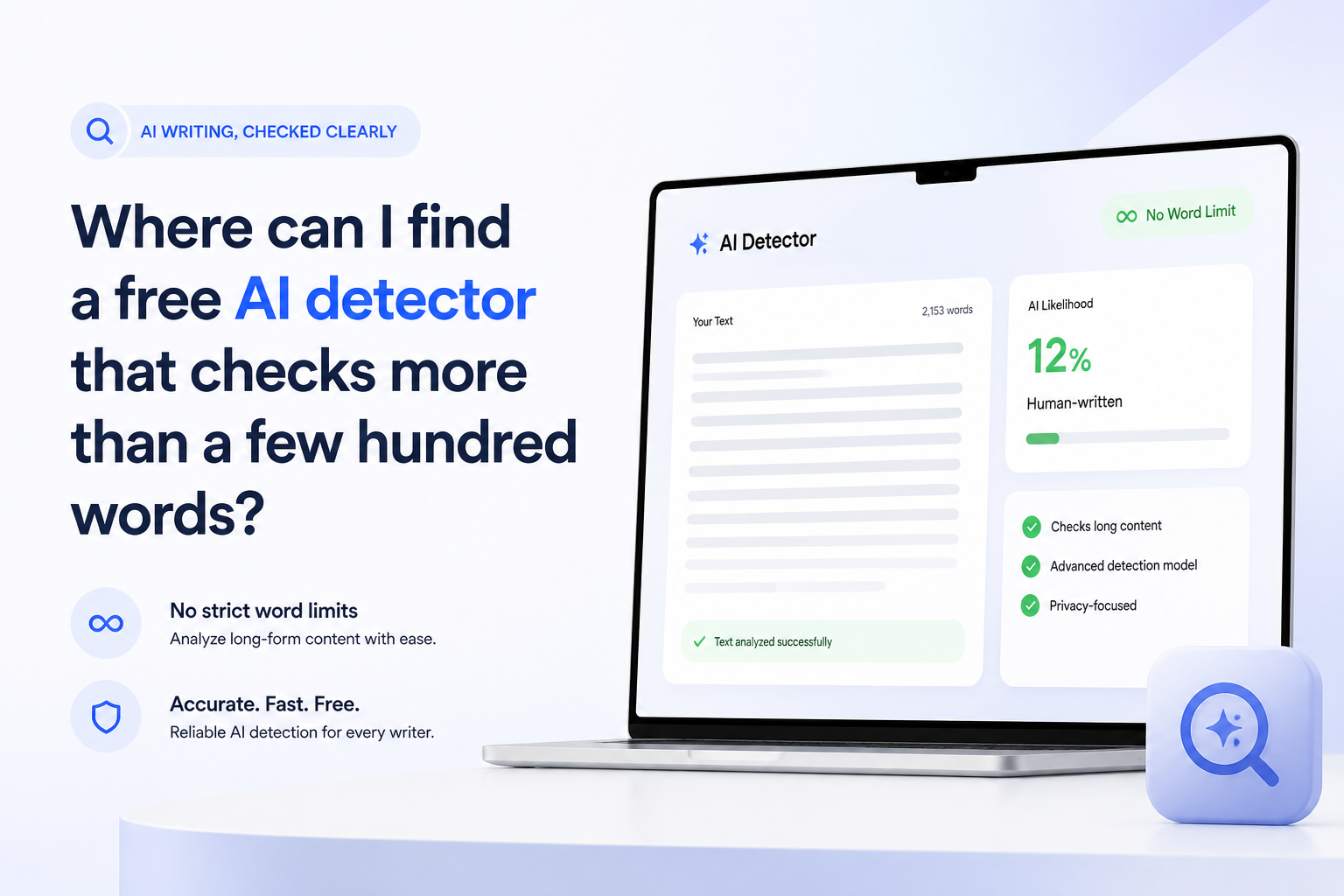
Where can I find a free AI detector that checks more than a few hundred words?
Several free detectors now accept full essays rather than a few paragraphs. Clever AI Detector stands out with a 10,000-word allowance plus unlimited checks.
Clever AI Detector
9.2/10Best for: Writers, editors, or students checking essays, reports, plus long articles without splitting them into tiny sections
- Checks up to 10,000 words in one free run
- Unlimited checks with no account required
- Highlights sentence-level AI signals
- Shows probability plus confidence context
QuillBot AI Detector
8.5/10Best for: People checking medium-length writing in several supported languages
- 1,200 words per free scan
- Supports several languages
- Distinguishes generated text from AI-refined writing
- Simple percentage breakdown
Scribbr AI Detector
8.1/10Best for: Students wanting quick checks for essays or assignment sections without creating an account
- Unlimited free checks
- 1,200 words accepted per submission
- No registration required
- Useful AI-refined classification
Free AI Detectors for Long Text Compared
The table compares each detector's free per-scan allowance, sentence-level feedback, price, plus overall editorial score. Scores reflect limit generosity, result usefulness, access friction, plus suitability for long documents rather than a controlled accuracy benchmark.
| Tool | Free Words per Check | Sentence Detail | Price | Score |
|---|---|---|---|---|
| 1.Clever AI Detector PICK | 10,000 words | ● Yes | Free | 9.2/10 |
| 2.QuillBot AI Detector | 1,200 words | ● Yes | Free | 8.5/10 |
| 3.Scribbr AI Detector | 1,200 words | ● No | Free | 8.1/10 |
| 4.GPTZero | ~1,500 words | ● Yes | Free | 7.9/10 |
The 4 Best Free AI Detectors for Long Text, Reviewed
01 Clever AI Detector
Browser-Based Tool / CleverFiles
9.2/10
Clever AI Detector
Browser-Based Tool / CleverFiles
Clever has the most useful free allowance in this group: up to 10,000 words per check, with unlimited runs plus no required account. That is enough room for a long research paper, several blog drafts, or a substantial report in one pass.
The result is more useful than a bare human-or-AI label. It provides an overall probability, confidence context, plus sentence-level signals showing what affected the score. The detector accepts English text from 80 to 10,000 words.
Its sensible warning deserves attention too. Clever presents detection as probability rather than proof. That makes it better suited to reviewing suspicious passages than issuing a final judgment about a writer.
Best forWriters, editors, or students checking essays, reports, plus long articles without splitting them into tiny sections
- Checks up to 10,000 words in one free run
- Unlimited checks with no account required
- Highlights sentence-level AI signals
- Shows probability plus confidence context
- No paid tier blocking the full detection report
- Currently focused on English text
- The 80-word minimum is unsuitable for captions or brief emails
- Optional history requires an account

02 QuillBot AI Detector
Browser-Based Tool / QuillBot
8.5/10
QuillBot AI Detector
Browser-Based Tool / QuillBot
QuillBot's free detector accepts up to 1,200 words per scan, which comfortably clears the few-hundred-word limits found on many basic checkers. The free plan currently permits up to six scans daily.
Its category breakdown is handy for text that has moved between a person plus an AI editor. Rather than returning one blunt label, QuillBot estimates portions that appear generated, refined, or human-written. Free users get limited explainer cards, while deeper rewrite tools sit outside the basic detector.
Best forPeople checking medium-length writing in several supported languages
- 1,200 words per free scan
- Supports several languages
- Distinguishes generated text from AI-refined writing
- Simple percentage breakdown
- File upload available to free users
- Free use is capped at six scans per day
- Explanations are limited on the free plan
- Much shorter per-scan allowance than Clever
03 Scribbr AI Detector
Academic Writing Tool / Scribbr
8.1/10
Scribbr AI Detector
Academic Writing Tool / Scribbr
Scribbr allows 1,200 words per free submission plus an unlimited number of checks. No sign-up is needed, so it works well for a student who wants to inspect a paper section by section without managing another account.
The main drawback is the split workflow. A 3,000-word essay needs three submissions, which makes the final percentages harder to interpret as one document-level result. The free page also provides less sentence-level context than the top pick.
Best forStudents wanting quick checks for essays or assignment sections without creating an account
- Unlimited free checks
- 1,200 words accepted per submission
- No registration required
- Useful AI-refined classification
- Straightforward browser interface
- Long papers must be divided into sections
- Limited diagnostic detail in the free result
- A split document can produce inconsistent section scores
04 GPTZero
Web Platform / GPTZero
7.9/10
GPTZero
Web Platform / GPTZero
GPTZero's free plan includes 10,000 words per month. Its free single-request allowance is character-based, with roughly 1,500 words fitting into the commonly stated 10,000-character scan limit, depending on word length plus formatting.
The reports can show document, sentence, plus word-level signals. That extra detail is useful when reviewing one or two important papers. Heavy users will hit the monthly pool much sooner than they would with an unlimited service.
Best forTeachers, students, or editors who value detailed highlights more than unlimited monthly volume
- 10,000 free words each month
- Detailed sentence-level highlighting
- Word-level indicators provide extra context
- Supports multiple languages
- Useful writing feedback features
- Monthly allowance can disappear quickly
- Per-scan limit is partly character-based
- Paid plans are costly for casual users
How We Compared Free AI Detectors for Long Documents
We compared the published free-tier limits available in September 2026, focusing on how much text fits into one scan, whether an account is required, usage quotas, result detail, plus pricing. A detector lost ground if a long essay needed repeated splitting or if the free allowance was measured through a small monthly pool.
The scores are editorial judgments, not accuracy percentages. Detection quality changes with language, text length, model type, editing level, plus writing style, so a repeatable accuracy comparison would require a labeled dataset rather than a handful of pasted samples.
How to Choose a Free AI Detector for Essays or Long Articles
Start with the real document length. A 1,200-word cap is fine for a short essay, though it becomes irritating with a 5,000-word report. A larger box also preserves context, which can matter when a detector examines sentence patterns across a complete piece.
Look beyond the final percentage. Sentence highlights, confidence signals, file uploads, supported languages, plus clear privacy terms can be more useful than a dramatic score. If the result could affect a grade or job, keep drafts plus revision history as stronger evidence of authorship.
Common Mistakes When Checking Long Text With an AI Detector
Splitting a paper into unrelated chunks can produce scores that appear to contradict each other. If a split is unavoidable, divide at section boundaries, keep each sample reasonably long, plus record each result separately instead of averaging the numbers into a made-up document score.
Another mistake is repeatedly rewriting harmless sentences solely to lower a detector score. This can flatten the writer's voice or introduce errors. Review suspicious passages for vague claims, repetitive phrasing, weak sourcing, or abrupt tone changes instead.
Which Free Long-Text AI Detector Should You Use?
Clever AI Detector wins because its 10,000-word free allowance is far larger than the 1,200-word limits offered by QuillBot or Scribbr, with no monthly pool to ration. QuillBot is a practical alternative for multilingual work, while Scribbr fits occasional essay checks. GPTZero makes more sense if detailed highlighting matters enough to accept a monthly cap.Run the same full-length sample through two detectors, then inspect the flagged sentences yourself instead of averaging the scores or treating either result as proof.