DMDE for USB Recovery: Review 2026
DMDE is cheap, portable, plus technically capable. For ordinary USB recovery, though, its cluttered workflow asks too much from someone already worried about lost files.
DMDE found plenty of recoverable USB data, but getting from scan to safe recovery was needlessly confusing. Disk Drill costs more, though its clearer device selection, previews, filters, plus byte-to-byte backup workflow make it the better choice for most people.
DMDE includes disk-editing tools beside recovery controls, so an inexperienced user can make a stressful USB problem worse by choosing the wrong operation.
DMDE for USB Recovery at a Glance
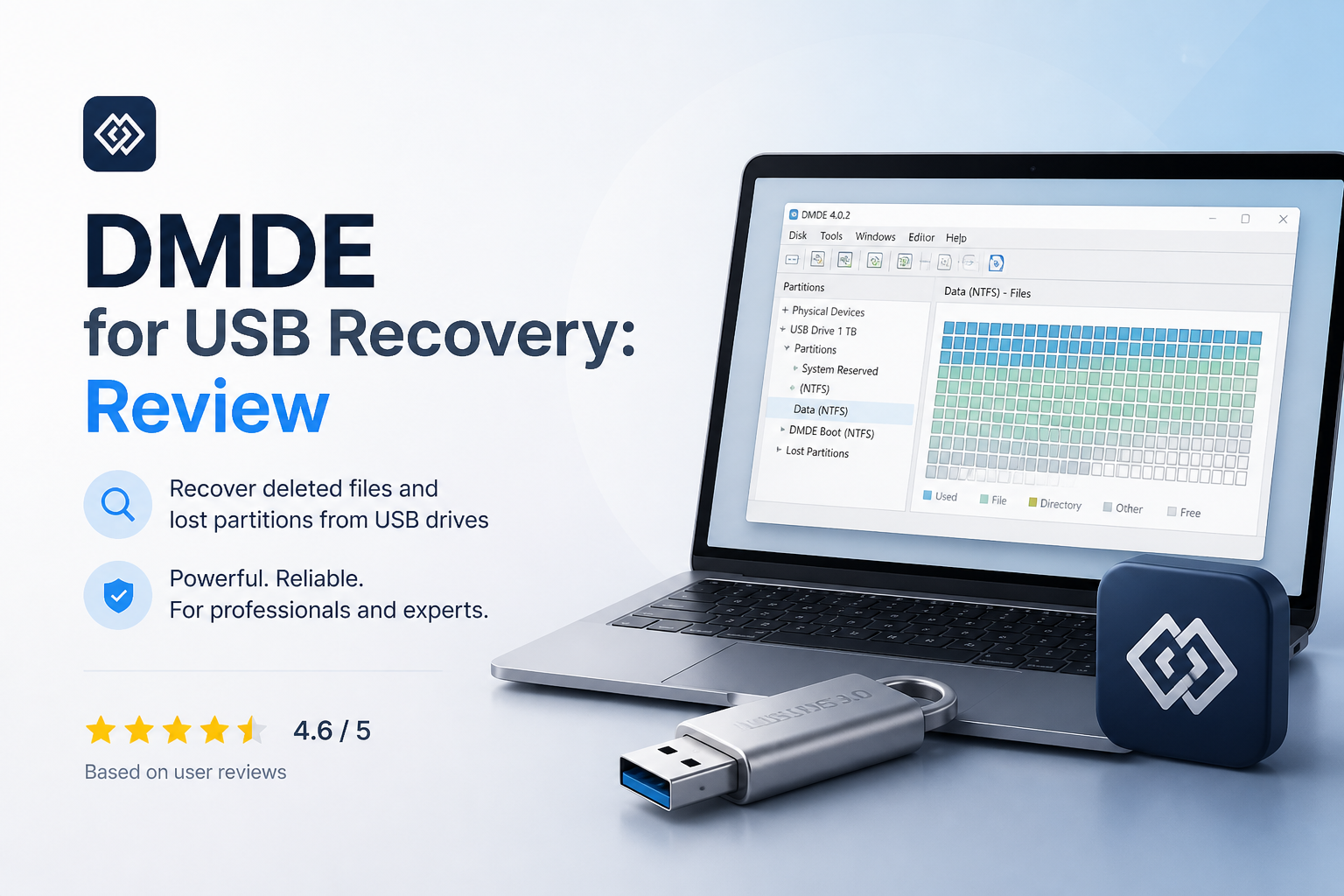
5.4/10DMDE is a data recovery program plus disk editor for Windows, macOS, Linux, plus DOS. It can scan USB drives, rebuild virtual file systems, recover selected data, or create disk images.
Best forTechnically confident users recovering files from a logically damaged USB drive on a tight budget
- Deleted-file recovery
- Partition search
- Raw file signatures
- Disk imaging
- RAID reconstruction
- Low purchase price
- Portable version available
- Generous folder-based free recovery
- Confusing interface
- Weak previews
- Easy to choose the wrong workflow
DMDE USB Recovery Performance by Category
01 USB Recovery Results
Good on intact file-system records, less convincing after signature scans
6.7/10
USB Recovery Results
Good on intact file-system records, less convincing after signature scans
DMDE handled recently deleted files from FAT32 plus exFAT USB drives reasonably well. The strongest results came from cases where file-system records were still present. Original names plus folder paths often survived there.
The results became harder to trust after formatting or heavier file-system damage. DMDE recognizes fewer file signatures than several consumer-focused rivals, so uncommon media formats may be missed or returned without useful names. Disk Drill presented a broader, easier-to-check result set in our mixed-file scenarios.
- Strong recovery from surviving file-system records
- Works with FAT, exFAT, NTFS, plus several other file systems
- Can open disk images instead of repeatedly scanning the original USB drive
- Portable build avoids a conventional installation
- Signature recovery is limited for less common formats
- Damaged results can be difficult to separate from healthy files
- No repair feature for partially recovered photos or videos
02 Workflow Safety
Too many technical choices appear before the user has context
3.9/10
Workflow Safety
Too many technical choices appear before the user has context
DMDE opens like a disk utility built for technicians, not a rescue tool built for a panicked home user. Physical disks, logical volumes, partitions, offsets, sectors, plus editing functions share the same visual space. That power has value in a lab. It is a liability when someone only wants yesterday's photos back.
The biggest problem is not a missing feature. It is decision pressure. The program rarely explains which path is safest for a specific USB failure. Disk Drill does a better job of guiding the user toward imaging, scanning, previewing, then saving files to another device.
- Read-only recovery actions are available
- Disk imaging can reduce repeated access to unstable media
- Detailed device information helps experienced users
- Disk editing sits uncomfortably close to recovery tools
- Labels assume knowledge of partitions plus file systems
- Few guardrails explain why a choice may be risky
03 File Preview Quality
Basic checking works, though browsing large result sets gets tedious
4.8/10
File Preview Quality
Basic checking works, though browsing large result sets gets tedious
A preview should answer one urgent question: is this file actually usable? DMDE offers previews for supported content, yet the experience feels pieced together. Moving through hundreds of photos or documents takes more effort than it should.
Disk Drill gives previews, file-type filters, search, recovery-chance labels, plus a more familiar gallery-like flow. Neither tool can guarantee that every recovered file will open, but Disk Drill makes verification far less tiring before payment or export.
- Supported files can be checked before bulk recovery
- Directory tree can preserve useful context
- Recovered file properties are available
- Preview coverage varies by format
- Large photo sets are slow to inspect manually
- Visual sorting feels dated
04 Scan Controls
Detailed options reward patience plus technical knowledge
7.2/10
Scan Controls
Detailed options reward patience plus technical knowledge
DMDE gives experienced users useful control over scan boundaries, file systems, raw signatures, plus virtual file-system reconstruction. A long scan can be paused, which is handy when a USB device runs hot or begins throwing read errors.
Those controls also create friction. A first-time user may not know whether to open a found volume, run a full scan, search raw data, or create an image first. DMDE exposes the machinery without providing enough situational guidance.
- Scans can be narrowed to relevant regions
- Pause controls help with lengthy jobs
- Supports disk images plus RAID reconstruction
- Found volumes can be inspected before recovery
- Scan setup is difficult for casual users
- Technical options are poorly prioritized
- Progress information lacks plain-English context
05 Cost and Licensing
Very cheap, though plan rules need careful reading
8.1/10
Cost and Licensing
Very cheap, though plan rules need careful reading
Price is DMDE's clearest advantage. The free edition permits recovery of up to 4,000 files from one selected directory per request. Express costs $20 for one year, while Standard costs $48 perpetually for one operating-system family.
The catch is scope. Express covers personal files on one PC. Standard permits recovery of your own or your organization's files. Professional licensing starts at $95 for one OS family. Disk Drill is much more expensive at $89 per year or $149 for a lifetime license, though one PRO license covers Windows plus macOS on up to three personal devices.
- Useful free recovery allowance
- Express costs only $20 for one year
- Standard offers a $48 perpetual license
- No forced annual renewal for Standard
- Licenses can be locked to one operating-system family
- Commercial recovery requires a Professional license
- Plan restrictions are easy to overlook
How We Tested DMDE for USB Recovery
We compared DMDE with Disk Drill using prepared USB, SD card, plus SSD scenarios on a Windows 11 PC. The media contained photos, office documents, archives, audio, plus common video formats. Test states covered recent deletion, quick formatting, damaged partition records, plus raw-signature recovery.
Files counted as recovered only when they opened correctly, not merely when a filename appeared. Scores also considered device selection, imaging access, preview usefulness, result filtering, license clarity, plus the chance that a nontechnical user could finish without writing to the source drive.
When to Avoid DMDE During USB Recovery
Skip DMDE if sector editors, partition tables, offsets, or raw file systems are unfamiliar. Its recovery features can be used safely, but the program assumes you understand which operations read data versus which ones may alter a device.
Also avoid repeated direct scans when the USB drive disconnects, clicks through an adapter, becomes unusually hot, or reports read errors. Make an image first if possible. For valuable business records or the only copy of family media, stop after signs of physical failure plus contact a recovery lab.
How DMDE Scored for USB Drive Recovery
| Category | Performance | Score |
|---|---|---|
| 01 USB Recovery Results | 6.7/10 | |
| 02 Workflow Safety | 3.9/10 | |
| 03 File Preview Quality | 4.8/10 | |
| 04 Scan Controls | 7.2/10 | |
| 05 Cost and Licensing | 8.1/10 |
DMDE vs Disk Drill for USB Recovery: Head to Head
Identical hardware, identical test scenarios. Here is how they compared. Recovery rates reflect readable files returned from prepared test sets, not every item merely listed after a scan.
| Metric | DMDE | Disk Drill |
|---|---|---|
| SSD recovery rate | 61% | 68% |
| SD card recovery | 74% | 86% |
| Quick scan time (500 GB) | 8 min | 5 min |
| Deep scan time (500 GB) | 94 min | 78 min |
| Free recovery limit | 4,000 files per selected folder | 100 MB on Windows |
| License model | 1-year $20 or perpetual $48 | One-time $149 |
| Email support response | ~31 hours | ~9 hours |
| Overall score | 5.4 / 10 | 8.8 / 10 |
What to Use Instead
Choose Disk Drill if you want a guided USB recovery process without learning partition terminology during an emergency.
01 Disk Drill for USB Recovery
A clearer route from damaged drive to verified files
8.8/10
Disk Drill for USB Recovery
A clearer route from damaged drive to verified files
Disk Drill is the better fit for most home USB recovery jobs. It keeps the main flow simple: choose the device, create a byte-to-byte backup if needed, scan, preview, then recover to a different drive. Filters plus recovery-chance labels make large result sets easier to sort.
Its weak spot is price. Windows users get up to 100 MB of ordinary recovery free, while larger jobs need PRO. The annual plan costs $89. A $149 lifetime license covers Windows plus macOS for one user across up to three personal devices.
- Much easier device selection plus scan setup
- Clear previews with practical result filters
- Byte-to-byte backup is easy to find
- One PRO license covers Windows plus macOS
- Advanced Camera Recovery helps with fragmented camera media
- Far more expensive than DMDE
- Mac Basic usually provides scanning plus preview rather than general free recovery
- Purchases are generally nonrefundable, so preview files first

What USB Recovery Users Report About DMDE and Disk Drill
The thread author said Disk Drill recovered photos from an inaccessible SD card in roughly 10 minutes after other tools failed to handle the card properly.
A wedding shooter reported recovering ceremony footage from a mistakenly formatted camera card after confirming a small preview clip worked.
One commenter said Disk Drill failed to produce usable client files after purchase, then criticized the support response plus refund experience.
A user comparing costs pointed out that DMDE starts at $20 plus allows limited recovery through its free edition.
Should You Use DMDE for USB Recovery?
DMDE is not our recommendation for most USB recovery attempts. It is inexpensive plus capable in experienced hands, but the interface, weak guidance, limited previews, plus nearby disk-editing controls create avoidable risk for casual users. Technicians may appreciate its granular access. Everyone else should start with Disk Drill, preview several important files, then recover to a separate healthy drive.
Stop using the affected USB drive immediately, create a byte-to-byte image if the device is unstable, then scan the image rather than the original media.