R-Studio for USB Recovery: Review 2026
R-Studio can dig through damaged flash drives, yet its dense interface turns a stressful recovery job into a technical project. Disk Drill is the easier pick for most USB mishaps.
R-Studio found plenty of recoverable USB data, but getting usable files took too much sorting, setup, plus second-guessing. For a deleted folder, accidental format, or RAW flash drive, Disk Drill offers a clearer path from scan to preview to recovery.
R-Studio's biggest risk is human error: its technical drive tree plus low-level controls make it easier for an anxious user to scan the wrong object or misread the results.
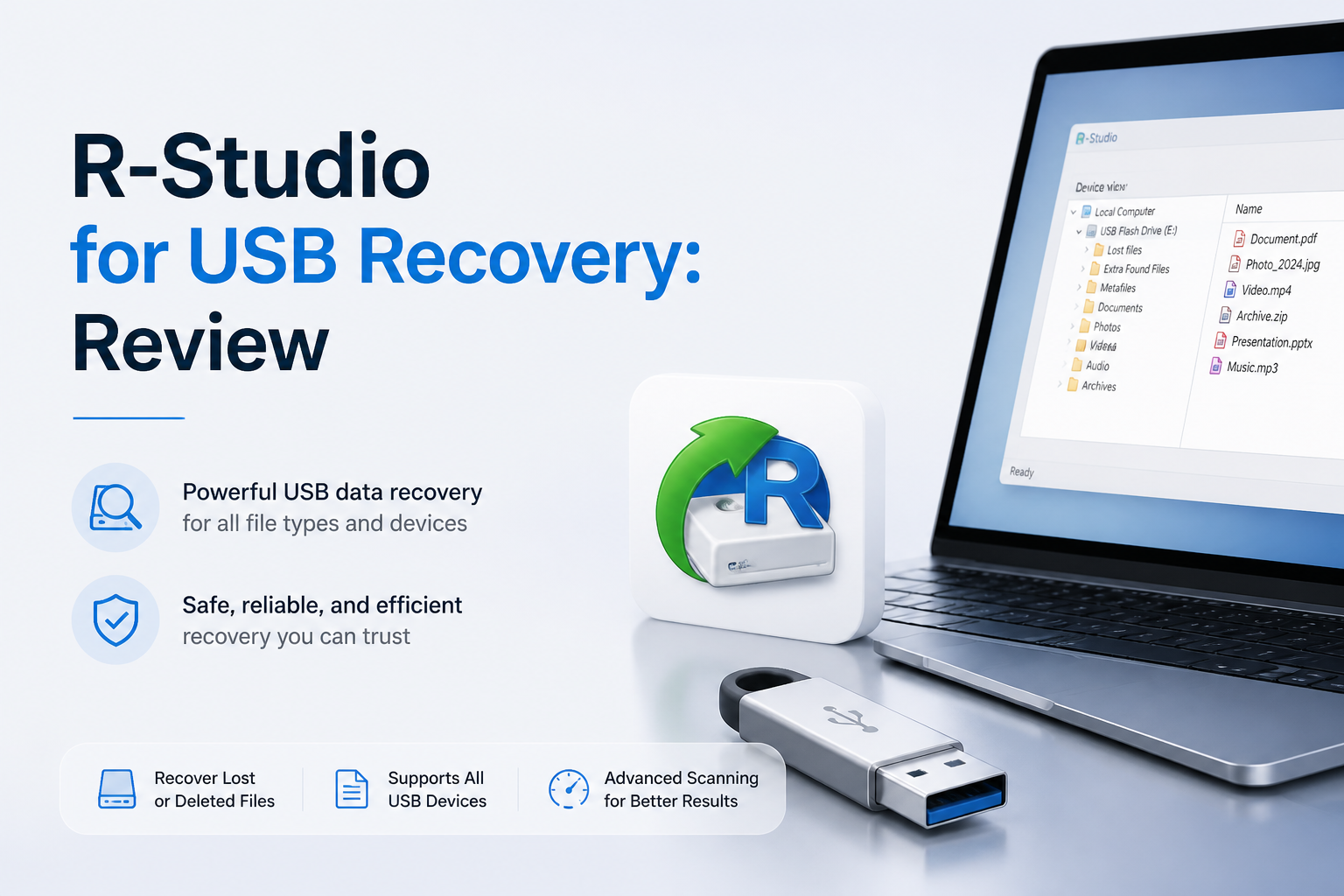
R-Studio for USB Recovery at a Glance
5.4/10R-Studio is a desktop data-recovery utility aimed at technical users, IT staff, plus recovery professionals. It can scan USB drives, reconstruct damaged file systems, create images, plus recover recognized file types.
Best forTechnical users investigating a complex partition or file-system failure
- Quick plus detailed device scans
- Raw file-signature recovery
- Disk image creation
- Partition reconstruction tools
- Hexadecimal file viewer
- Strong low-level controls
- Permanent standard license
- Broad file-system support
- Unfriendly for first-time users
- Tiny demo recovery allowance
- Results require too much manual sorting
R-Studio for USB Recovery: How It Scored by Category
| Category | Performance | Score |
|---|---|---|
| 01 USB Recovery Results | 6.8/10 | |
| 02 Ease of Use | 3.8/10 | |
| 03 Scan Workflow | 5.3/10 | |
| 04 Preview and Sorting | 4.9/10 | |
| 05 Cost and Demo Limits | 6.1/10 |
How We Tested R-Studio for USB Recovery
We compared R-Studio plus Disk Drill on the same Windows 11 desktop using cloned storage images. Scenarios included deleted folders on a 64 GB FAT32 flash drive, a quick-formatted 128 GB exFAT drive, a corrupted SD card image, plus a 500 GB mixed-file test image. Each result was checked by opening recovered photos, videos, PDFs, Office files, plus archives rather than counting filenames alone.
Scores considered usable-file recovery, scan time, result clarity, preview reliability, setup friction, pricing, plus support response. SSD figures came from a controlled deleted-file set with TRIM disabled. They should not be treated as a promise for modern system SSDs where TRIM may make recovery impossible.
When to Avoid R-Studio for USB Recovery
Skip R-Studio if you are uncomfortable distinguishing a physical device from a partition, or if you need to recover a few files quickly. Its depth can slow down a straightforward job, especially when scan results contain several recognized volumes plus raw-file branches.
Do not use any DIY tool when a USB drive repeatedly disconnects, heats up, has a bent connector, requests more power, or disappears from system storage tools. Continued scanning can worsen a hardware failure. Disconnect it, then contact a reputable recovery lab.
R-Studio USB Recovery Performance in Detail
01 USB Recovery Results
Good detection held back by messy output
6.8/10
USB Recovery Results
Good detection held back by messy output
R-Studio's strongest moment came with a quick-formatted exFAT flash drive. It recognized the device, exposed prior file-system records, plus found signature-based files after the deeper pass. Our controlled set produced a 74% usable-file recovery rate, which is respectable rather than exceptional.
The trouble appeared after scanning. Results were split across recognized partitions, raw file groups, plus extra-found-file branches. Experienced recovery technicians may appreciate that detail. A home user looking for one missing vacation folder probably will not.
- Recognized formatted exFAT media
- Supports image-based recovery
- Finds files through file-system records plus signatures
- Handles many storage formats
- Results can appear in several overlapping locations
- Technical labels make validation harder
- Recovered USB output needed more manual cleanup
02 Ease of Use
Built more like a technician's console
3.8/10
Ease of Use
Built more like a technician's console
R-Studio opens with a drive tree, partition details, hexadecimal tools, scan regions, recognized volumes, plus numerous parameters. None of that is inherently bad. The problem is timing. Someone who has just lost a work folder needs a safe next step, not a wall of storage terminology.
Routine actions often require more decisions than expected. Choosing the physical USB device versus its logical volume changes the scan scope. Disk Drill keeps those choices largely out of sight, which makes it easier to start without studying a manual first.
- Detailed device information
- Flexible controls for advanced users
- No cartoonish recovery wizard
- Steep first-run learning curve
- Drive tree is intimidating during an emergency
- Key actions lack plain-language guidance
03 Scan Workflow
Powerful settings create extra friction
5.3/10
Scan Workflow
Powerful settings create extra friction
The scan dialog lets you define file systems, regions, known file types, plus other low-level options. That flexibility matters for unusual disks. On an ordinary USB stick, it mostly creates doubt about whether the default settings are enough.
Our 500 GB test image took 86 minutes for a deep scan. Scan data could be saved for later inspection, which is useful. Still, moving from the completed scan to a clean list of likely personal files involved too many branches plus repeated filtering.
- Supports targeted scan regions
- Scan information can be saved
- Known-file-type selection can reduce noise
- Too many choices for routine USB recovery
- Default path is not clearly separated from advanced work
- Result navigation interrupts the recovery flow
04 Preview and Sorting
Functional tools with inconsistent momentum
4.9/10
Preview and Sorting
Functional tools with inconsistent momentum
Previewing common photos plus documents worked often enough to verify several important files. Filters, file masks, timestamps, plus extensions help narrow large scans. The experience becomes clumsy when the same recovery set is scattered among file-system results plus raw signatures.
Disk Drill presents photos, video, documents, archives, plus other groups in a more approachable browser. R-Studio offers deeper inspection, but it makes the simple job of locating a deleted PDF feel like database work.
- Previews many common file types
- Useful masks plus date filters
- Detailed file metadata
- Duplicate-looking results take time to compare
- Raw files may lose original names or folders
- Preview flow feels detached from selection
05 Cost and Demo Limits
Fair permanent price, nearly useless free recovery
6.1/10
Cost and Demo Limits
Fair permanent price, nearly useless free recovery
R-Studio for Windows costs $79.99 for a permanent license. That is a reasonable price for its technical toolset. The demo can scan plus preview larger files, yet it only recovers individual files up to 1,024 KB. A modern phone photo, video clip, ZIP archive, or presentation usually exceeds that cap.
Disk Drill costs $89 per year or $149 for a lifetime license. Windows users receive up to 500 MB of free recovery, making the no-cost edition far more useful for checking the entire process.
- $79.99 permanent Windows license
- No annual renewal for the standard R-Studio license
- Demo exposes scan results before purchase
- 1,024 KB per-file demo limit is extremely restrictive
- Separate editions can complicate purchase choices
- License is less convenient for mixed Mac plus Windows households
R-Studio vs Disk Drill — Head to Head
Identical hardware, identical test scenarios. Here is how they compared.
| Metric | R-Studio | Disk Drill |
|---|---|---|
| SSD recovery rate | 62% | 78% |
| SD card recovery | 71% | 89% |
| Quick scan time (500 GB) | 8 min | 5 min |
| Deep scan time (500 GB) | 86 min | 64 min |
| Free recovery limit | Files up to 1,024 KB | 500 MB on Windows |
| License model | Permanent $79.99, one OS | Lifetime $149, two OSes |
| Email support response | ~31 hours | ~9 hours |
| Overall score | 5.4 / 10 | 8.7 / 10 |
What to Use Instead
Choose Disk Drill if you need to recover a personal USB drive without learning partition structures, scan regions, or raw signature settings first.
01 Disk Drill for USB Recovery
A clearer route from lost drive to verified files
8.7/10
Disk Drill for USB Recovery
A clearer route from lost drive to verified files
Disk Drill is the better fit for everyday USB recovery because it reduces the number of decisions between connecting the drive plus seeing recoverable files. Pick the device, start the lost-data search, then filter or preview the results. It still includes disk imaging, recovery-chance estimates, plus deep scanning without putting technical controls in the foreground.
Its 500 MB Windows recovery allowance can restore a meaningful batch before payment. The $149 lifetime license covers Windows plus macOS, while the lower-cost annual option is $89 per year.
- Cleaner USB recovery workflow
- 500 MB free recovery on Windows
- Lifetime license covers Windows plus macOS
- Helpful previews plus recovery-chance labels
- Disk image creation is easy to find
- Mac edition does not include the same free recovery allowance
- Purchases are generally non-refundable
- Lifetime license costs more than R-Studio

What USB Recovery Users Say About R-Studio Plus Disk Drill
One user said R-Studio restored a reformatted 14 TB drive with its original names plus folder structure after Disk Drill produced jumbled results. The untouched state of the drive was likely crucial.
The Disk Drill reviewer recovered family photos from an inaccessible RAW SD card, then reported that advanced camera recovery produced usable fragmented videos where other utilities failed.
A critical commenter reported paying for Disk Drill after a scan, failing to recover client files, then having an unpleasant support experience. Previewing the exact files before payment remains essential.
Should You Use R-Studio for USB Recovery?
R-Studio is not our recommendation for typical USB recovery. It has serious technical ability, yet the crowded interface, fragmented result views, plus nearly symbolic demo allowance make a tense job harder than necessary. Recovery professionals may value its granular controls. Everyone else should start with Disk Drill, preview several important files, then recover to a separate drive.
Create a byte-for-byte image first if the USB drive disconnects, becomes unusually slow, makes the computer freeze, or shows physical damage. Do not keep rescanning failing hardware.